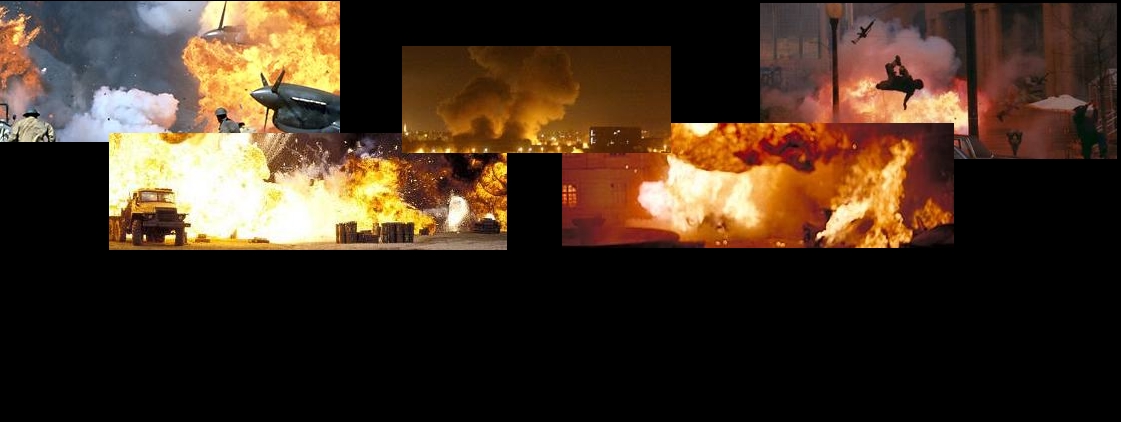
This depends a lot on the type of explosion one is trying to achieve.Particle explosions tend to look less dense than fluid explosions as they are mainly suspended particles on fire.Therfore,it depends a lot on whether a person is trying to achieve the look of a Suspended Particle explosion or Liquid/Vapour explsosion.
The pros of "fluids" is that it includes a voxel based renderer which is great for the volumetric effects of explosions but the down side is that it is slow. The other advantage is the actual fluid dyanimics engine which is great also for gasses and smoke simulations.
Particles can create a range of effects including ones that utilize aspects of the fluids technology in maya. In comparison it can be faster for some effects but more difficult to acheive certain effects that fluids can do really well but slowly. If you use the hardware renderer for hardware particle shading types it is very fast.But Particles have other disadvantages.
Particle systems tend to ignore several issues:
1. Explosions have a "shock wave" that causes reflections, diffractions, and rapid change in the level of energy. These properties cannot be represented through particles.
2. Dust clouds which result from an explosion is computationally difficult to calculate in a particle system.
3. The fireballs created with a particle system are typically spherical, rather than following the fluid dynamics model of real fire.
4. Particle systems do not easily allow for refraction of light due to the shock wave and heat associated with an explosion.
5. Particle systems work poorly when they have to interact with objects such as buildings, mountains, or other natural environments.
Also,a combination of Particles and Fluids could also give the user great flexibility and nice looking results.Although unless this technique is used with 2D fluid containers,the running time is too high.
[
Back
]