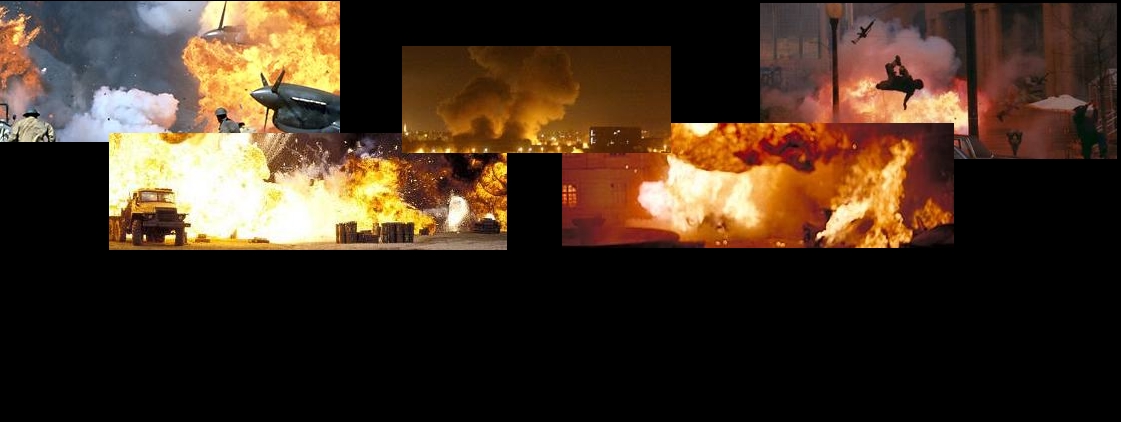
OTHER TECHNIQUES
Most of the research in Animating explosions has gone into the modeling and animation of the blast wave.The paper "Animating Suspended Particle Explosions" (Feldman, B. E., O'Brien, J. F., Arikan, O.) was the first one that focussed on modelling of the flame associated with the explosion rather than the blast wave.The method uses an inxompressible fluid simulation with contraints on the divergence of the fluid flow.

These were some of the examples using their method.
Example1
Example2
Rather than modeling the numerically troublesome, and largely invisible blast wave, the method uses a relatively stable incompressible fluid model to account for the motion of air and hot gases. The fluid's divergence field is adjusted directly to account for detonations and the generation and expansion of gaseous combustion products. Particles immersed in the fluid track the motion of particulate fuel and soot as they are advected by the fluid. Combustion is modeled using a simple but effective process governed by the particle and fluid systems. The method has enough flexibility to also approximate sprays of burning liquids.
The paper "Animating Explosions" (Gary D. Yngve,James F. O'Brien,Jessica K. Hodgins,GVU Center and College of Computing) uses a physically-based model to simulate the effects.The propagation of an explosion is simulated through the surrounding air using a computational fluid dynamics model based on the equations for compressible, viscous flow. To model the numerically stable formation of shocks along blast wave fronts, an integration method is employed that can handle steep pressure gradients without introducing inappropriate damping. The system includes two-way coupling between solid objects and surrounding fluid. Using this technique, a variety of effects has been generated including shaped explosive charges, a projectile propelled from a chamber by an explosion, and objects damaged by a blast.
An Example using this method: Example3
USING 2D CONTAINERS TO SIMULATE A 3D EXPLOSION
Though Maya Fluid Dynamics has given users flexibility to create more convincing exoplosions,large physically-based simulations take a long time to run and render,which makes it tough to control.One way of working around this,and reducing the rendering time of an Explosion by using 2D fluid containers to give the impression of a 3D explosion.The principle behind it is that the 2D fluid simulations is used to get a velocity vector which is used to drive the particles according to their position .This method combines the benefits of both particles and fluids.

By running the simulations in two dimensions instead of three, we can run at high resolutions(e.g. 256X256) and still at almost interactive rates. So it is possible to do a lot of tests and fine tune the settings in a short time.This is a small simulation to show how it works in Maya.
Fluid simulation clip
[
Back
]
|