PHYSICS BEHIND EXPLOSIONS
WHAT ARE THEY?
An Explosion is a sudden release of energy,that cause a wave to propogate owtwards,called a Blast Wave.
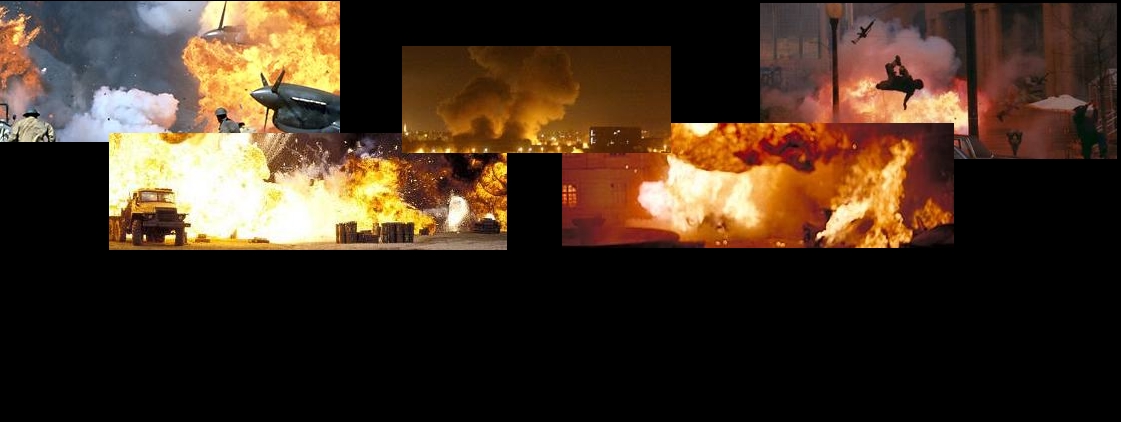
The blast wave is an explosion's primary effect, but it moves at supersonic speeds and its only visible manifestation is a subtle refraction of light. Except for extremely large, powerful explosions, the refraction effect is almost completely invisible. Secondary effects may include bright flashes of light, flame, dust, and flying debris. These secondary effects can be quite visibly noticeable and are the ones that we visually associate with explosions.
THE BLAST WAVE
The blast wave shocks up, creating a nearly discontinuous jump in pressure, density, and temperature along the wave front. The wave is substantially denser than the surrounding fluid, allowing it to travel supersonically and to cause a noticeable refraction of light. The air at the shock front compresses, turning mechanical energy into heat. The waves reflect, diffract, and merge, allowing them to exhibit a wide range of behavior. An explosion causes a variety of visual effects in addition to the light refraction by the blast wave. An initial chemical or nuclear reaction often causes a blinding flash of light. Dust clouds are created as the blast wave races across the ground, and massive objects are moved, deformed, or fractured. Hot gases and smoke form a rising reball that can trigger further combustion or other explosions and scorch surrounding objects.

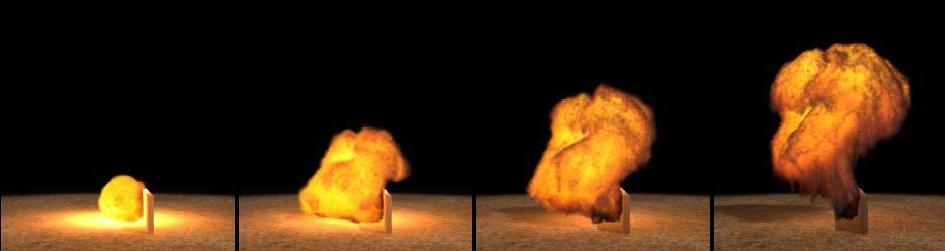
The Figure shows a cross-section of pressures for a three-dimensional explosion near a wall. The initial disturbance in the rst image interacts with the surrounding fluid and causes a pressure wave to propagate through the medium. In the second image, the blast wave has shocked up, as is evident by the large differences in pressure across the shock front. The blast wave reflects of the wall and the ground in the third image. In the fourth, the wave that reflected of the ground merges with the initial blast wave to form a Mach stem, which has pressure values twice that of the initial wave. In the final two images, the blast wave crests over the wall and forms a weaker diffracted wave.
WHAT CAUSES THEM?
They may be caused by Mechanical,Chemical,Nuclear or Other events.
Some of the simplest Natural explosions occur due to interactions between Liquids.
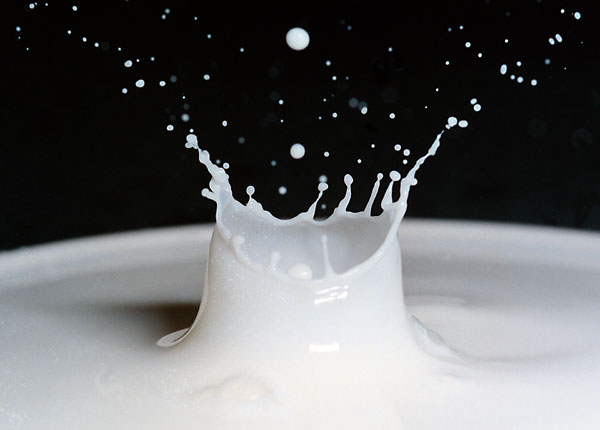
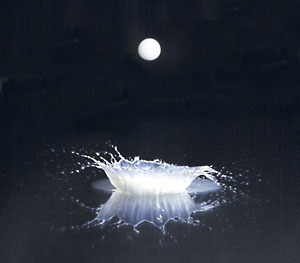
Figure 1:Natural Explosions
Bigger Natural explosions are also caused by Volcanic processes,Geysers, Underwater Vents and Earthquakes.
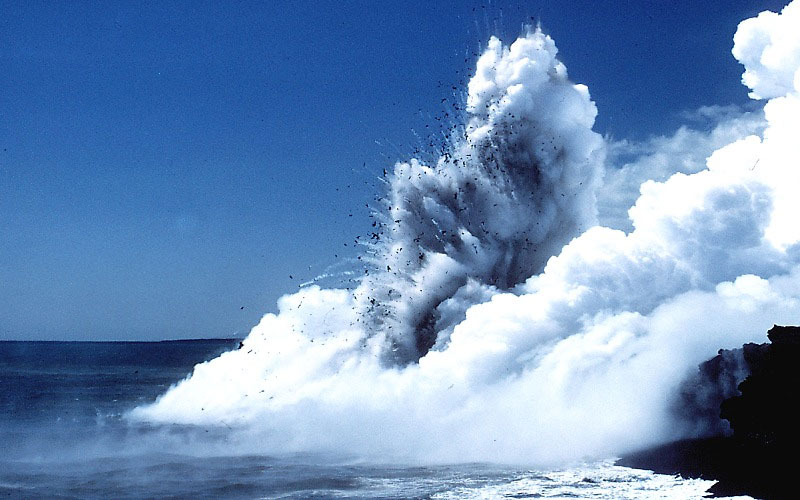
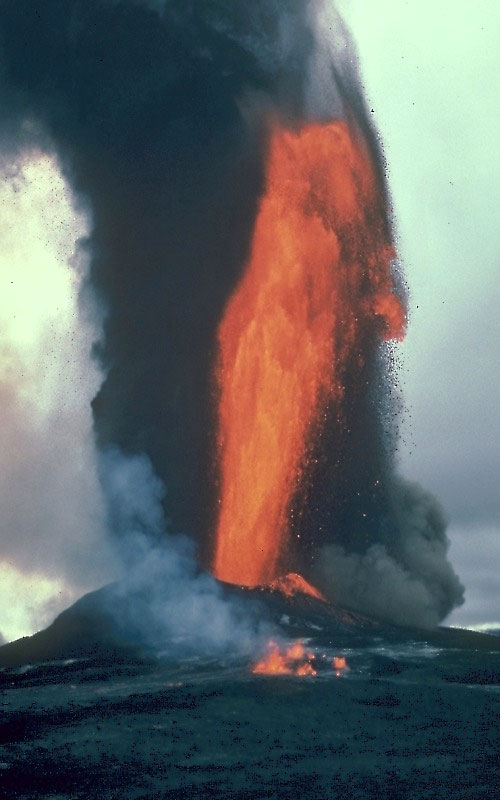
Figure 2: Steam and volcanic Explosions
[
Back
]